PADRE ISLAND HOUSING REPORT – DECEMBER 2025

Corpus Christi Association of Realtors has posted the Padre Island Corpus Christi Housing Report for December 2025.

December closed the year with a clear message for Padre Island. The market slowed, but it did not slide. Prices held. Inventory grew. Buyers paused. Sellers adjusted.

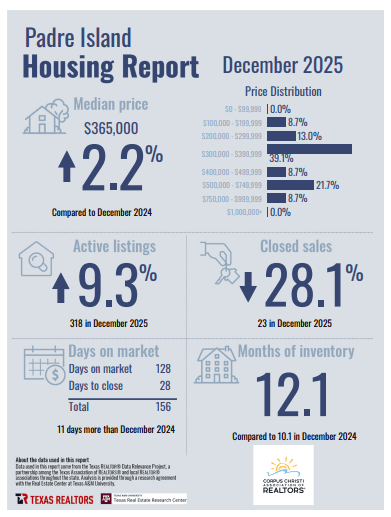
At the start of the month, the median home price landed at $365,000. That number sits 2.2 percent higher than December 2024. This matters. Even with fewer sales and more listings, prices stayed resilient. The island did not give back ground.

Most activity clustered in the middle of the market. Homes priced between $300,000 and $399,999 made up 39.1 percent of all sales. This range remains the heartbeat of the island. The next strongest segment came from homes priced between $500,000 and $749,999 at 21.7 percent. Entry level inventory stayed thin, with very little movement below $200,000.

Inventory told a different story. Active listings rose 9.3 percent year over year, ending December with 318 homes on the market. Buyers saw more options than they have in several years. Sellers faced more competition, especially in higher price ranges.

Sales activity slowed sharply. Only 23 homes closed during the month, a 28.1 percent drop compared to last December. Higher borrowing costs and cautious buyers stretched decision timelines. Fewer deals closed, but serious buyers stayed engaged.

Time on market continued to lengthen. Homes averaged 128 days before going under contract, followed by another 28 days to close. From list to finish, the process now averages 156 days. That is 11 days longer than last year. Speed favors sellers who price correctly and prepare well. Everyone else waits.

The clearest signal came from months of inventory. Padre Island ended December at 12.1 months. Last year closed at 10.1 months. This shift confirms a buyer favored environment. Choice returned. Negotiation returned. Balance moved.

This market did not collapse. It reset. Prices remained firm because people still want to live here. Sales slowed because buyers became selective. Inventory grew because sellers stayed confident.

Padre Island closed 2025 steady, not rushed and not overheated. Buyers gained breathing room. Sellers gained clarity. The island kept its long term appeal, driven by lifestyle, location, and limited land.

Padre Island’s newest development Whitecap NPI is open for sales of their lots in Phase 1, Contact Coastline Properties owner Cheri Sperling for all pre-sales. sperling@coastline-properties.com

Cheri Sperling is the owner of Coastline Properties with a dedicated team of agents specializing in residential listings, sales, and property management in the Padre Island Corpus Christi real estate market. Coastline’s team is the most knowledgeable real estate office on Padre Island. No pressure style, patience, and an intimate understanding of the local market. They go to work for you!


Padre Island Corpus Christi December 2025 Data (Click Pic below for Larger Image)

padre-island-corpus-christi-housing-report-december-2025

Prep For The Cold?

BREAKING NEWS: Winter is upon us. “So what” you say? We live in S. Texas – it’s always warm, sunny, driveway drinks and pool parties weather around here. MYTH. We can and do get freezes! Who remembers February 2021? That was pretty extra, and as atypical as it was, history CAN repeat itself.

I know we’re all tempted to start purchasing heat lamps and tents for our palms and delicate landscaping, but if you are among the majority who have children, pets, or anything with a heartbeat living under your roof, it’s best to learn from last year’s unfortunately scary and chilly events that to be prepared for inside is the best thing you can do.

Here are the top 5 ways to plan ahead to alleviate some of the discomforts of inclement weather.

  1. GENERATOR – get one. Any one. Small one, big one, an automatic one, propane tank one, whole-home, portable…red one, blue one, get one, run run. You will not want the precious food (or beer) in your fridge to spoil, and you want to be able to at least turn on a small-space portable heater. IF your fridge isn’t going to run on the generator you have, pull out what’s important to you and put it outside! You have a FREE freezer on your patio.
  2. PIPE INSULATION – remember having no water? Or worse yet, no water AND a burst line? Head to your favorite hardware store and grab some pipe insulation. Know where your main water line is and make sure you have enough insulation (or in a clutch situation, blanket and lots of duct tape) to wrap it. Let your faucets drip slowly to keep that water moving, and it is less likely to freeze. In the unfortunate event of a burst, turn them off immediately.
  3. HEAT SOURCE – if you failed to grab that generator, have a backup plan! If you have a fireplace, stockpile wood (and keep the flue closed when not in use!). Gas cooktops? Make sure you have a lighter to spark that bad boy up. If you followed rule #2, you’ll have water to boil for noodles, baby bottles, sponge bath…and while I give you a moment to get your mind out of the gutter…clear THEM, too! If there is debris in them, that melting ice could drip into your attic. Make sure your doors and windows have tight seals to keep drafts out.
  4. CHARGERS – have your battery packs ALL juiced up so you do not end up with a dead cell phone and no way to communicate with the outside world. Or no way to keep yourself entertained…Netflix never sounded so good. Furthermore, have a full tank of gas in your car in the event you DO need to charge your devices from there!
  5. STOCK UP – on weighted blankets, board games, books, wool socks, candles, beef jerky (a personal favorite but any non-perishable protein of your preference!), water (and wine…), flashlights and batteries, first-aid kit, and perhaps make an extra effort at making nice with your neighbors. Sometimes they’re the real saviors with a hot pot of coffee or a quick shower.

I repeat: we CAN and DO freeze! Stick to this top 5 list first, and pray we can save it all for 2072.

A 6 Percent Mortgage Rate Could Ignite the Next Wave of Home Buying

In recent weeks, mortgage rates have decreased, which is significant for the Corpus Christi home market. The 30-year fixed mortgage is predicted by many forecasters to reach 6% in the upcoming year. Many local buyers were priced out by rates close to 7% at the beginning of 2025. Reduced prices restore affordability and reopen doors around the Coastal Bend.

The National Association of REALTORS’ research demonstrates the magnitude of this shift. Approximately 5.5 million households countrywide are added to the buying pool with a one percent decrease in mortgage rates. Approximately 1.6 million of them currently rent. This is significant locally since there are many renters in Corpus Christi who are ready to buy a property when monthly payments start to decline.

Lower rates trigger action fast. First-time buyers feel the benefit first, especially residents facing rising rents across the city. Lower borrowing costs also shift behavior among existing homeowners. Many local owners hold mortgages locked in at lower rates from earlier years. As rates ease, more choose to sell and move, which adds inventory to the market and gives buyers more options.

NAR expects mortgage rates to reach 6 percent in 2026. This outlook reflects several forces shaping borrowing costs. Federal Reserve rate cuts influence short-term rates. Inflation trends matter. Federal debt levels, tariffs, quantitative tightening, and movement in the 10-year Treasury yield also affect mortgage pricing.

Mortgage rate sensitivity explains why this moment matters so much for Corpus Christi.

The local market moved through one of the most affordability-strained periods in years. Home prices rose, but higher mortgage rates created the biggest barrier. Between mid 2022 and late 2023, rates jumped from near 3 percent to above 7 percent. Monthly payments increased by more than $1,000 compared to pre-pandemic levels. Limited inventory across Corpus Christi added pressure and paused buyer activity.

A move from 7 percent to 6 percent changes who can qualify in this market. Rates near 6 percent remain higher than the historic lows of 2020 and 2021, yet the difference of one percentage point reshapes buying power for many local households.

Here is a clear example tied to local price ranges.

On a $500,000 home with a 30-year loan at 7 percent and a 10 percent down payment, the monthly payment runs about $3,895. At 6.25 percent, that payment drops to roughly $3,672. The savings equal $223 each month. Over one year, that adds up to more than $2,600. For many Corpus Christi buyers, this gap determines whether a purchase moves forward.

Markets respond quickly when rates ease.

Across Texas and other coastal states, sales activity picks up as borrowing costs fall. This pattern matters for Corpus Christi, where buyer demand has waited for affordability to improve. Lower rates release pent-up demand from residents who paused their plans over the past two years.

What this means for Corpus Christi is that buyer confidence can return!

NAR data shows a drop from 7 percent to 6 percent unlocks demand at scale.

In the Corpus Christi metro area:

• The share of households qualifying for a mortgage rises by 5.7 percent.
• At a 6 percent rate, 55.4 percent of households qualify.

If mortgage rates fall from 7 percent to 6 percent:

• 8,921 additional households can afford the median-priced home.
• About 10 percent of those households move forward with a purchase.
• Roughly 892 additional home sales follow over the next 12 to 18 months in Corpus Christi.

For buyers watching the local market, this shift matters. Lower rates expand access. Monthly payments ease. More homeowners list their properties. Buyers who prepare early place themselves in a stronger position as Corpus Christi moves into its next phase of housing activity.

PADRE ISLAND HOUSING REPORT – NOVEMBER 2025

Corpus Christi Association of Realtors has posted the Padre Island Corpus Christi Housing Report for November 2025.

Our active listing median prices have slightly declined the past month to $458,000 which is actually a 5.6% decrease from where it was compared to last November at this time! CCAR shows us the data that has increased for active listings to 18% with a total of 367 properties this past month compared to November 2024 while inventory rose to 13.6 compared to 11.1 last year at this time.

Days on the market has increased this past month with an average of 159 days and the highest categories for sales with 23.5% of all the sales being priced between $200,000 – $299,999 and $400,000 – $499,000 respectively.

The BUYER’s market continues as we wrap up the year, and we are all eager to see what is in store for 2026. Give us a call and you so we can show you what living on Padre Island is all about.

Padre Island’s newest development Whitecap NPI is open for sales of their lots in Phase 1, Contact Coastline Properties owner Cheri Sperling for all pre-sales. sperling@coastline-properties.com

Cheri Sperling is the owner of Coastline Properties with a dedicated team of agents specializing in residential listings, sales, and property management in the Padre Island Corpus Christi real estate market. Coastline’s team is the most knowledgeable real estate office on Padre Island. No pressure style, patience, and an intimate understanding of the local market. They go to work for you!


Padre Island Corpus Christi November 2025 Data (Click Pic below for Larger Image)

padre-island-corpus-christi-housing-report-november-2025

Great Tips for Holiday House Hunting

holiday-house-hunting

This time of year typically marks the unofficial time people begin thinking about the holidays. After Halloween, time seems to speed up, and before we know it the holiday parties, charity functions, and the like set in for families. Real estate activity during the holiday season is typically discouraged because of the challenges posed on both sides of a transaction.

For sellers, there is the inconvenience of having to keep the home clean, leaving on a moment’s notice for showings, and limiting holiday entertaining. For buyers, there may be limited access to houses if sellers place showing restrictions due to personal schedules and commitments.

However there are some advantages and  other considerations that both sides should keep in mind.

This year we have many homes on the market, the homes that are available have highly motivated sellers. This may provide a better negotiating climate, and there is less likely to be the type of competition for homes you see during high season. In turn, sellers will find equally motivated buyers, and may find that offers and closings move more quickly.  What this means is, bargains and negotiations are plentiful this time of year if you are working with a savvy real estate agent in corpus christi.

Holiday sellers should curb large plans to entertain, have family & friends stay over, or do excessive decorating. Focus on showing off the features of your home that will appeal to a buyer – not your family decorations and holiday traditions.  It sounds like a less attractive holiday, but the dividends will more than pay for themselves.  Remember to always keep a mindset of a buyer in mind.  Have a Happy and healthy holiday season!

Truth about the Option Period in a Real Estate Contract!

Did you know?

Did you know the standard contract for buying a home in Texas contains a clause for an Option Period?

The Option Period is the time during which the buyer can cancel the contract for any reason, without penalties. A buyer pays for the option period, usually a small amount of $100 and for a standard of 10 days. During this 10 days, the buyer can run inspections and negotiate any repairs with the seller. If an agreement cannot be made, the buyer can back out of the contract with only losing the $100. If the buyer does purchase the property, the $100 is credited to them at closing.

One thing that many realtors, buyers and sellers often question is when the option period starts. A contract is executed and binding when both parties agree and have both signed the contract. This is considered the executed date which is written into the contract above the sellers and buyers signatures. The option period starts the next day.

Example: If a buyer and seller agree and sign on November 20, 2025, the option period would start on November 21, 2025 and end at midnight on November 30, 2025.

An option period is the best money a buyer can spend when purchasing a home!

PADRE ISLAND HOUSING REPORT – OCTOBER 2025

Corpus Christi Association of Realtors has posted the Padre Island Corpus Christi Housing Report for October 2025.

Our active listing median prices have risen the past month to $451,500 which is actually a 18.4% decrease from where it was compared to last October at this time! CCAR shows us the data that has increased for active listings to 21.8% with a total of 385 properties this past month compared to October 2024 while inventory rose to 14.2 compared to 11.3 last year at this time.

Days on the market has declined this past month with an average of 139 days and the highest categories for sales with 26.7% of all the sales being priced between $500,000 – $749,999.

The BUYER’s market continues, they are some fantastic deals out there right now! Give us a call and you so we can show you what living on Padre Island is all about.

Padre Island’s newest development Whitecap NPI is open for sales of their lots in Phase 1, Contact Coastline Properties Agent Ms. Amber Spicak at their office for all pre-sales. amber@coastline-properties.com

Cheri Sperling is the owner of Coastline Properties with a dedicated team of agents specializing in residential listings, sales, and property management in the Padre Island Corpus Christi real estate market. Coastline’s team is the most knowledgeable real estate office on Padre Island. No pressure style, patience, and an intimate understanding of the local market. They go to work for you!


Padre Island Corpus Christi October 2025 Data (Click Pic below for Larger Image)

padre-island-corpus-christi-housing-report-september-2025

National Diabetes Awareness Month

Every year the month of November is recognized as Diabetes Awareness Month. The purpose of this month is to raise awareness regarding the disease since millions of Americans live with diabetes. According to the American Diabetes Association, 37.3 million Americans have diabetes. Additionally, 96 million people are categorized as pre-diabetic which is a condition where glucose levels are higher than normal but not yet high enough to be considered diabetes. This is an important month to learn about diabetes due to the high number of Americans diagnosed with diabetes.

The objective of Diabetes Awareness Month is to increase public knowledge of diabetes. There are two types of diabetes. The first is Type 1 which accounts for 5-10% of all diabetes and is typically diagnosed in children and young adults. Type 1 diabetes occurs when the body does not produce insulin. The exact cause of Type 1 diabetes is unknown, but it is generally thought to be caused by a combination of genetics and an immune system disorder that affects insulin-producing cells in the pancreas. Individuals with Type 1 diabetes are generally required to monitor their blood sugar levels closely and take insulin daily to survive. The other form of diabetes is Type 2 diabetes which is the most common form of diabetes. Type 2 diabetes develops over time and occurs when the body becomes insulin resistant, meaning it is unable to process insulin properly.

Currently, there is no cure for diabetes. However, Type 2 diabetes can be manageable and, in some instances, preventable. According to the American Diabetes Association, Type 2 diabetes can be managed by taking prescription medicines, following a healthy eating plan, reducing tobacco use, and exercising to ensure blood sugar levels are kept within a healthy range. Similarly, those who are pre-diabetic or who are at a high risk of developing Type 2 diabetes can delay or even prevent the onset of the disease by making changes towards living a healthier lifestyle.

For more information about diabetes, please visit the American Diabetes Association www.diabetes.org.

Additionally, you visit the Texas Department of State Health Services to learn more about treatments for diabetes https://www.dshs.texas.gov/txdiabetes/.

If you have questions regarding any of the information mentioned in this week’s article, please do not hesitate to call my Capitol or District Office. Please always feel free to contact my office if you have any questions or issues regarding a Texas state agency, or if you would like to contact my office regarding constituent services. As always, my offices are available at any time to assist with questions, concerns or comments (Capitol Office, 512-463-0672; District Office, 361-949-4603).

– State Representative Todd Hunter, District 32

Rep. Hunter represents Aransas County and part of Nueces County. He can be contacted at todd.hunter@house.texas.gov or at 512-463-0672.

Fresh Paint Still Sells Homes Better Than Almost Anything Else

Every home tells a story. But before buyers ever listen, they look.

And what they notice first isn’t the new hardware, the upgraded fixtures, or even the landscaping. It’s the walls.

A new coat of paint still beats almost any other home improvement when it comes to getting a property ready to sell. A Better Homes and Gardens Real Estate survey found that three out of four real estate agents believe repainting adds the most value before a sale, sometimes boosting a home’s worth by as much as 10 percent.

Josh McGrath, broker and owner of Better Homes and Gardens Real Estate Central, puts it simply: if you have a thousand dollars to spend, spend it on paint.

“It’s the most cost-effective upgrade,” he says. “You can cover the most space for the least money. Even if you paint the walls the same color, it feels new again. The dents and dings are gone. The space feels cared for.”

That’s what buyers notice. Not just the color, but the freshness.

A freshly painted home signals something deeper. It tells buyers the owners paid attention. It suggests a house that has been maintained, not just decorated. Even the scent of new paint can make a showing feel cleaner and more inviting, setting the tone before buyers notice anything else.


The Psychology of Color

Real estate agents see it every day. Color changes how people feel the moment they step inside a home.

In the same survey, red topped the list of dealbreakers. Too bold, too loud, too much energy for a space meant to feel calm. “Red has subliminal messaging,” McGrath says. “It means stop, it means caution. Great for a restaurant, not for a living room.”

Other bold shades like orange, neon, or deep purple made buyers uneasy too. The colors might express personality, but in real estate, personality takes a back seat to possibility.

That’s why neutrals still lead the market. Whites, grays, and beiges continue to dominate, with new blends like Sherwin-Williams’ Worldly Gray, a soft mix of beige and gray, bridging the gap between warm and cool tones.

Neutrals invite imagination. They don’t demand attention; they hold space for it. A freshly painted blank wall helps buyers envision their furniture, art, and life. That quiet psychological effect can mean the difference between a showing and a sale.


What Works When Staging

When staging a home, the right color combinations don’t just make a space look better. They make it easier for buyers to imagine living there.

The BHGRE survey found these palettes stand out:

  • Beige and soft green — timeless and natural

  • White and gray — clean and modern

  • Navy and white — bold yet balanced

  • Black and gold or taupe and teal — elegant accents for higher-end listings

Even when homeowners aren’t changing colors, they half repaint just to refresh. The logic is simple: buyers expect homes to feel as new as possible.

“Think about buying a pre-owned car,” McGrath says. “You expect it to be detailed, clean, looking nice, smelling fresh. Paint does that for a house.”


The Quiet Power of Renewal

Whether you’re selling or staying, repainting every few years keeps a home feeling alive. “Life leaves marks on the walls,” McGrath says. “A fresh coat of paint brings it back.”

In the end, paint isn’t just color. It’s care made visible. It’s the sign of a homeowner who understands the small details that make a big impression.

And when buyers walk through the door, that’s what sells.

What Happens to Real Estate When the Government Shuts Down

When the federal government closes, real estate feels it first.

Behind every sale, mortgage, or permit are government-backed systems that make homeownership possible. Flood insurance, FHA and VA loans, rural housing programs, and federal verifications all rely on staff and systems that stop or slow when Washington grinds to a halt.

On a recent episode of The Advocacy Scoop, NAR’s Shannon McGahn and Patrick Newton explained what really happens during a shutdown and how REALTORS® help keep the market steady when uncertainty rises.


A Modern Habit Washington Cannot Shake

Government shutdowns were not always part of the American budget cycle. Before the 1970s, if Congress failed to pass spending bills, federal agencies kept operating, assuming new funding would arrive soon. That changed in 1980 when a Justice Department ruling made it illegal for agencies to spend money without congressional approval.

Since then, shutdowns have become a regular feature of politics. McGahn called it “a reality, not a new one, but a consistent one.”

When Congress fails to pass all twelve annual appropriations bills, parts of the government lose legal authority to operate. To avoid this, short-term fixes known as continuing resolutions are sometimes used to buy time. But when those expire, the shutdown begins.


The Real Estate Ripple Effect

Few industries depend more on the federal government than real estate. Housing transactions are heavily regulated and insured, and that means any disruption quickly reaches buyers and sellers.

“Even if some functions continue, uncertainty slows deals,” McGahn said. “That is why we talk directly with lawmakers. Behind every delayed form or policy renewal is a family waiting to move.”

During a shutdown, the Federal Housing Administration, which insures about 15 percent of U.S. mortgages, faces reduced staffing. Loan processing slows, affecting first-time and lower-income buyers most. VA loans usually continue, but veterans often see delays in eligibility checks or customer service. Rural housing loans through the USDA stop entirely, halting transactions in many smaller communities.

The National Flood Insurance Program is another major concern. It has been kept alive through short-term extensions since 2017, often tied to broader spending bills. When the government closes, its authorization lapses unless Congress acts. Without it, tens of thousands of home closings in flood zones could stall, threatening roughly 1,400 transactions every day.

Existing policies remain valid for 30 days and can be transferred to new owners, but uncertainty spreads quickly. “It is not that everything stops on day one,” McGahn said. “But the longer a lapse lasts, the harder it becomes for people to close on their homes.”


Builders, Renters, and Confidence

The impact extends beyond buyers. Builders and developers face delays when they need federal permits or environmental reviews. HUD rental assistance payments can be held up, leaving housing providers waiting for funds. FHA condo approvals slow down, which affects new supply and development.

Even short shutdowns cause bottlenecks. Longer ones can ripple through markets for months, changing mortgage rates and shaking investor confidence.

Consumer confidence is often the hardest to protect. “Come and use this government program, but the government is shut down,” McGahn said. “That is a hard sell.”


REALTORS® as Advocates

NAR’s advocacy team prepares for these moments long before they happen. When shutdowns threaten, they launch immediate outreach to Congress through the Federal Political Coordinator network, mobilizing members across every district. Within 48 hours of this shutdown, NAR reached 70 percent of lawmakers to explain how the closures affect homebuyers and local economies.

That outreach has sparked bipartisan attention. Lawmakers from both parties have voiced support for keeping critical housing programs open. Behind the scenes, NAR continues meeting with White House officials and housing regulators to keep the focus on one goal: protecting access to homeownership.

Because when Washington closes its doors, the housing market still turns, and REALTORS® still show up for the people trying to move their lives forward.